


LALA DRONA
Lala Drona is a Franco-American artist of Venezuelan heritage based in Paris. A graduate of the Royal College of Art (MA Painting), she has exhibited internationally, including Immanence at Robegago Gallery, Paris (2026), and her work has entered institutional collections, including the Musée Artistes Femmes, Lausanne.
Her paintings explore what she calls the "Abject Feminine," turning away from external appearance to reveal the body as interior, visceral, and uncanny. Her protocol began with watching her own filmed surgeries on repeat, then relying on somatic memory to translate them onto canvas. She sees her paintings as bodies or sites which never truly resolve.
An artist shaped by reconstructive surgeries and a bi-cultural upbringing among internet pioneers and entrepreneurs, Drona paints from the traces of lived corporeality. This is dangerous art, art with real stakes: the kind that raises the pulse before it settles, holding the viewer there long enough to find the beauty inside the discomfort. The body in her work is not a subject to be depicted but a force that spills beyond containment, a condition that remains permanently open.
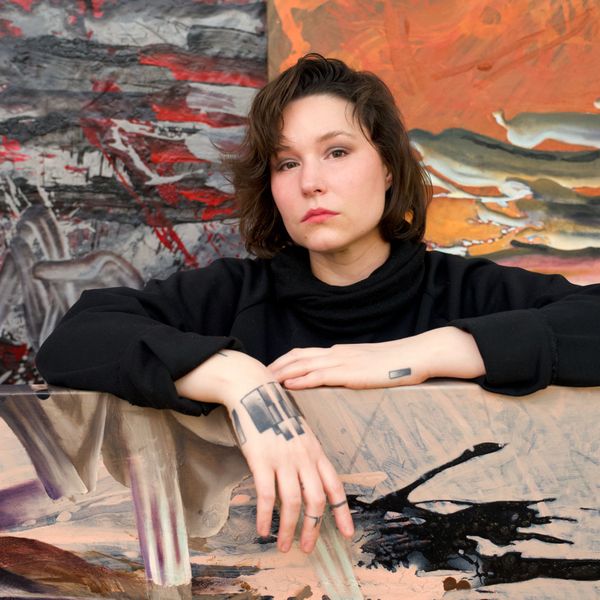
Interview of Lala Drona, produced by Emma Carmichael and Clarisse Fontainee for The Kumo Collective.
Artist Statement
Lala Drona is a Franco-American artist of Venezuelan heritage based in Paris. A graduate of the Royal College of Art (MA Painting), she has exhibited internationally, including Immanence at Robegago Gallery, Paris (2026), and her work has entered institutional collections, including the Musée Artistes Femmes, Lausanne.
Her paintings explore what she calls the "Abject Feminine," turning away from the body's surface to its interior: visceral, seeping, without edge. Organic forms surface like organs or tendons, carrying a structured violence, a machinery of flesh that never fully resolves. Through paint alone, the body comes to evoke technology: tissue that reads like circuitry, skin like an interface, until neither is legible on its own. Closer to Cronenberg's body horror than to any clean idea of the digital, it is no longer two things touching but two things refracting into one. The work stays unresolved in the way a body is unresolved, always becoming: wounded, growing, expelling, colliding with its environment, never settling into a single shape.
This is a practice built on discord and reclamation. She begins on the floor, recalling images from footage she filmed of her own breast reconstruction surgeries, watched for hours until memorized. There, on the floor, the canvas takes on a weight and pooling that belong only to that position: gravity and unconscious gesture take over, paint applied by hand rather than brush, until she releases control and follows the material instead of directing it. When the canvas moves vertically to the wall, paintbrushes and control return. She selects and defines the forms, pushing and pulling them into place. Yet the marks still carry a physics that no longer applies. The finished paintings feel displaced where they hang, still holding the memory of lying down. Stretcher as bone, canvas as skin, paint as the treatment tending to another body.
An artist shaped by reconstructive surgeries and a bi-cultural upbringing among internet pioneers and entrepreneurs, Drona paints from the traces of lived corporeality. This is dangerous art, art with real stakes: the kind that raises the pulse before it settles, holding the viewer there long enough to find the beauty inside the discomfort. The body in her work is not a subject to be depicted but a force that spills beyond containment, a condition that remains permanently open.